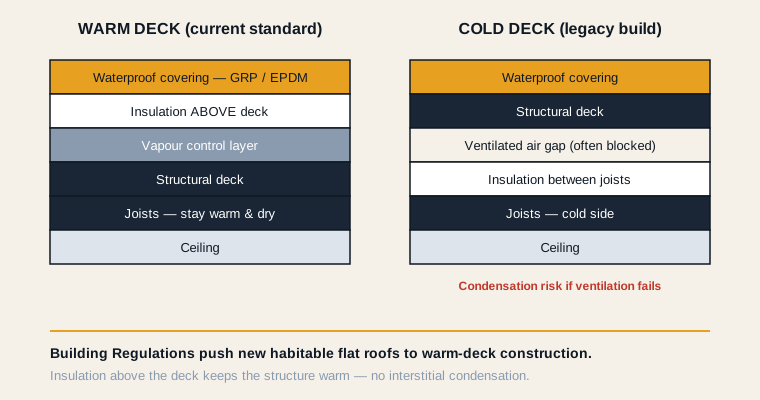
Malvern has a large stock of ageing felt flat roofs on extensions and garages. Here is how to tell yours needs attention.
The Barnards Green Factor in Flat roofing
On the 1930s bay-fronted semis the first thing to fail is usually the lead on the bay roofs and the bedding mortar on the ridges, both now well past their service life. On the streets around Barnards Green Road in particular, that is the fault we are called to most, and it is worth knowing what drives it before you pay anyone to fix it: the symptom you can see from the ground is rarely the whole story, and a Barnards Green flat roofing quote that skips a proper look is guessing.
When we take on flat roofing in Barnards Green, the first thing that shapes the job is the place itself. Barnards Green sits below the hills on the Poolbrook side, a settled residential quarter of inter-war and post-war homes. The stock is mostly 1930s semis and post-war housing, with bay-fronted inter-war homes carrying the lead and clay-tile detailing typical of the period. You see it clearly around the Poolbrook Road area, where the roofs tell you the era of the street at a glance.
We treat the bay roofs on these semis as their own small project, because the lead detailing there is where inter-war houses leak first. That local knowledge is the difference between a Barnards Green flat roofing job that lasts and one that has you calling someone back in two winters. It is also why we would rather turn down a job we cannot do properly than take it on and cut a corner the Barnards Green weather will find.
Reasonable side and rear access on most plots makes scaffold straightforward, though the bay roofs need careful edge protection. Sitting below the hills on the Poolbrook side, the area takes the valley humidity that slows autumn drying and feeds moss on shaded slopes. Both of those feed directly into what your flat roofing should cost and how long it takes, which is why we survey the actual property near Poolbrook Common rather than quoting from a national rate card — two houses a few streets apart in Barnards Green can need genuinely different work, and pricing them the same helps nobody.
All of this shows up in the price. A flat roofing quote for a property on the Poolbrook Road area will not match one for a different era of house two streets away, because lead and bedding-mortar failure on inter-war bay roofs and the access it needs are what actually drive the cost here. We would rather show you an itemised Barnards Green quote you can question line by line than a round number that hides where the money goes.
On the day in Barnards Green: for flat roofing here, scaffold is specified where the job involves first-floor extensions and any roof where edge protection is required for safe working, and where a tower or roof ladder is safe we use that instead to keep the cost and disruption down. Any pavement scaffold or skip licence goes through Malvern Hills District Council, which we arrange, and we plan it around Barnards Green’s reasonable side and rear access on most plots makes scaffold straightforward. You get a clear start date, a tidy site at the end of each day, and no surprise access charge appearing after work has begun — the single most common complaint we hear about the last firm someone used.
Do you cover all of Barnards Green?
Yes — we cover Barnards Green in full, from Barnards Green shops across to the surrounding streets, and we know the local stock well enough to price flat roofing accurately before we arrive.
What makes Barnards Green roofs different for flat roofing?
The local factor that matters most is lead and bedding-mortar failure on inter-war bay roofs, and it is made worse because valley humidity slows autumn drying. Knowing both is how we quote Barnards Green work fairly rather than off a national average.