An honest, no-jargon guide to the biggest question about your Malvern roof. When a repair is the smart money, when it is throwing good money after bad, and when a re-roof is simply oversell — explained both ways.
Tell us the job in 30 seconds. No pushy sales, no call-out fee.
The honest answer
Repair or Replace? How to Decide
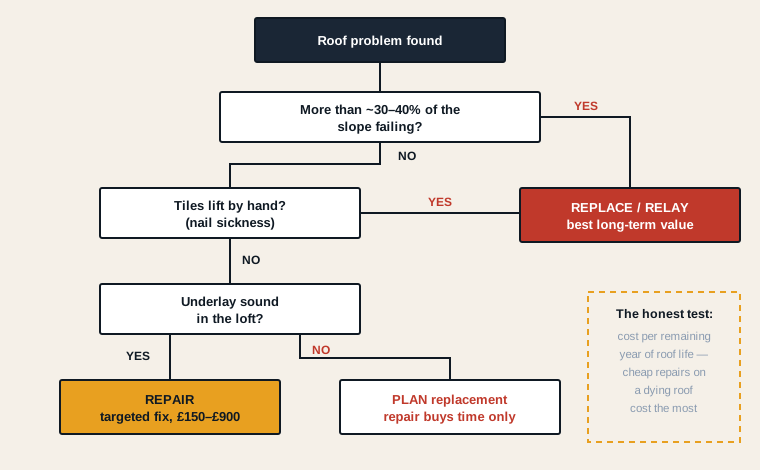
Repair if the covering is largely sound and the problem is localised; replace once failure is widespread or the fixings have gone across the whole roof. The rule of thumb: if more than about 30% of the roof has failed, or you are paying for repairs every year, replacement is usually the cheaper choice per remaining year of life.
Repair-or-replace decision tree weighing roof age, extent of failure and cost per remaining year.
Start here
Age & Condition by Malvern Stock Era
The right answer depends heavily on what you are standing under, and Malvern has several distinct eras of roof:
Victorian & Edwardian Welsh slate (Great Malvern, Malvern Wells hillside villas): natural slate lasts 80–120 years, but the iron nails holding it fail far sooner. If slates are slipping across the whole roof from nail fatigue, refixing a few is a losing battle and a re-slate is the honest answer. If only an isolated area has gone, a section re-slate saves the rest.
1930s clay tile: often still serviceable if maintained, but the bedding mortar and lead will be well past their life. Frequently a repair-and-maintain case rather than a full replacement.
1960s–70s concrete interlocking tile (Malvern Link, Pickersleigh, post-war estates): the tiles themselves fade and lose their surface but can last 50+ years; the underlay and fixings beneath usually fail first. Often a re-roof reusing sound tiles, or a felt-and-batten replacement.
Felt flat roofs (extensions, garages): a 15–20 year life. Past that, recovering in EPDM or GRP is more economical than chasing repairs.
The 30% rule
The 30% Rule of Thumb
Roofers use a simple test: if more than roughly a third of the covering has failed, repairing tile-by-tile is money wasted, because the areas you have not touched are about to fail next. Below that threshold, targeted repair is usually the sensible, cheaper option. It is not an exact science — a roof with one bad slope and three sound ones is a different case from one failing evenly all over — but it is a good sense-check against anyone pushing a full re-roof for what looks like a localised problem. On a Malvern roof, the honest way to apply it is to get up there and assess each slope, because a hillside villa often has one weather-beaten elevation that has failed while the sheltered slopes still have years left in them.
The maths
Cost Per Remaining Year
The figure that actually matters is cost per remaining year of roof life. A £600 repair that buys you three more years costs £200 a year. A £9,000 re-roof that lasts 60 years costs £150 a year — and comes with a guarantee and no more repair calls. When the repairs are coming every year or two, the re-roof quietly becomes the cheaper option, not the dearer one. We will do this maths with you honestly rather than steering you toward the bigger invoice.
When patching wastes money
When a Repair Is a False Economy
Patching is the wrong call when: slates or tiles are slipping across the whole roof rather than in one spot; you have paid for repairs two or three years running; the underlay has perished so every new leak is just the next weak point giving way; or the roof structure itself is sagging. In these cases each repair buys a few months and the money never stops. That is when replacement is the honest recommendation.
When replacement is oversell
When Replacement Is Oversell
Equally, replacement is oversell when: the covering is sound and only a section or the fixings in one area have failed; a single slipped tile or one tired flashing is the whole problem; or a firm is quoting a full re-roof off a photograph without getting up there to check. A reputable Malvern roofer should be willing to talk you out of a re-roof as readily as into one. If a quote feels like it is solving a small problem with the most expensive possible answer, get a second opinion — we are happy to give one, with no call-out fee.
Not sure which side of the line your roof falls on? A roof inspection gives you a written, photographed condition report and an honest recommendation, and the fee comes off any work you then book.
Flat roofs
Flat Roofs: A Different Calculation
Flat roofs follow their own logic. A felt flat roof on an extension or garage has a life of roughly 15 to 20 years; once it starts blistering, splitting or ponding, chasing individual repairs rarely pays because the whole membrane is at the end of its life at once. Recovering in modern EPDM rubber or GRP fibreglass typically costs little more than two or three repair visits, comes with a fresh guarantee, and buys you another 20 to 25 years. The exception is a genuinely young flat roof with a single isolated split from impact damage — that is worth repairing. But an ageing felt roof that has started to fail in several places is the clearest recover-not-repair case there is, and we will tell you so plainly.
The one real decision on a flat-roof recover is warm deck versus cold deck — where the insulation sits — and whether it is worth upgrading the insulation while the covering is off. On a room-over extension that matters for comfort and condensation; on a detached garage it usually does not. We explain which applies to yours rather than defaulting to the dearest build-up.
Worked examples
Three Malvern Roofs, Three Different Answers
The theory is clearer with real cases. Here are three Malvern roofs and why each got a different honest recommendation.
The Victorian villa, Great Malvern. A hillside villa off Graham Road with original Welsh slate, slates slipping on two of four slopes from nail fatigue. The sound slopes had years left, but refixing slipping slates one at a time would have meant a call-out every few months. The verdict was a section re-slate of the two failing slopes in matching slate, keeping the sound ones — roughly £4,000 against a £13,000 full re-roof, and no more slipping-slate calls. Repairing everything would have been a false economy; replacing everything would have been oversell.
The 1960s semi, Malvern Link. A concrete-tile semi on the Pickersleigh estate, tiles sound but the underlay perished and fixings failing across the whole roof, with three leaks in eighteen months. Here the 30% test was clearly passed — the whole roof was at the end of its fixing life at once. A full re-roof at around £6,500, reusing the still-good tiles where possible, worked out at about £110 a year over its life against repair bills that were already running at £400 a year and rising. Replacement was the cheaper answer, not the dearer one.
The 1930s semi, Barnards Green. A clay-tiled inter-war semi with one damp patch, traced to a single failed lead valley. The rest of the roof was in good order for its age. The verdict was a straightforward valley repair at a few hundred pounds — no re-roof needed, and none recommended. A firm quoting a full replacement here would have been solving a small, local problem with the most expensive possible answer.
A Malvern factor
Conservation Areas & Listed Buildings
Great Malvern's conservation area and the district's listed buildings add a consideration that pure cost-per-year maths misses. On these properties you may not be free to choose the cheapest covering: the local planning authority can require that repairs and replacements match the original in material and appearance — natural Welsh slate rather than concrete substitute, lime mortar rather than modern cement, clay rather than interlocking tile. That pushes the replacement cost up, which in turn shifts the balance further toward careful repair and section work wherever the original fabric can be saved. If your property is listed or in the conservation area, the decision is as much about consent and materials as it is about money, and we factor that in from the survey onwards.
Getting it right
How to Get an Honest Verdict
The single best defence against both a wasted repair and an unnecessary re-roof is a proper survey by someone who will get onto the roof and show you what they find. Ask for photographs of the actual problem. Ask what proportion of the roof has failed. Ask what a repair buys you in years, and what a replacement would cost per year over its life. Any roofer confident in their recommendation will answer all three without hesitation — and if the honest answer is that your roof has years left in it with a modest repair, that is exactly what you should be told. We would rather give you that answer and earn the next job than sell you a re-roof you did not need.
Common questions
Repair or Replace: Common Questions
The clearest signs are tiles or slates slipping across the whole roof rather than one area, repairs needed every year, a sagging roof line, or daylight visible through the loft. If more than about 30% has failed, replacement is usually the cheaper choice per remaining year.
A rule of thumb roofers use: if more than roughly a third of the covering has failed, repairing tile-by-tile is money wasted because the untouched areas are about to fail too. Below that, targeted repair is usually the sensible option.
Yes — a section re-slate or single-slope repair is often the honest answer when one area has failed but the rest is sound, and it saves the cost of a full re-roof.
Natural Welsh slate lasts 80–120 years, concrete tile 50+, and a modern felt or EPDM flat roof around 20–25. Correct fixing and the right underlay matter as much as the covering itself.
Often, yes. A quote well below honest ranges usually means a corner is about to be cut — thinner underlay, fewer fixings, or skipped lead. Insist on an itemised quote so you can compare like for like.
Get In Touch
Want an Honest Repair-or-Replace Verdict?
A free survey and written report tells you which your Malvern roof actually needs. No call-out fee.