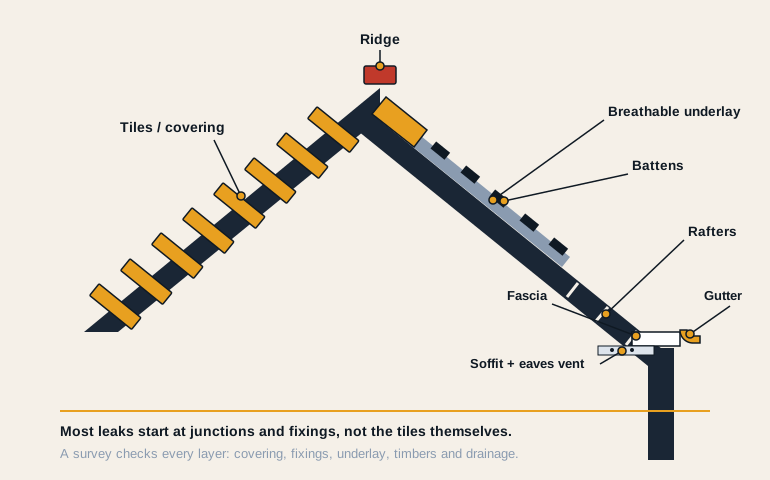
A survey turns an unknown roof into a costed plan. It is the cheapest money you can spend on an older Malvern property, and it stops you either ignoring a problem until it becomes expensive or being talked into work you do not need. A good survey tells you what is urgent, what can wait, and roughly what each will cost.
Why roof survey in Ledbury Is a Local Job
Getting roof survey right in Ledbury starts with understanding the local stock. Ledbury is a black-and-white market town over the Herefordshire border, where the oldest stock is timber-framed and the constraints are heritage ones. The historic core is timber-framed and Georgian, with steep, irregular roof planes, clay tile and stone, alongside Victorian and modern housing on the edges. You see it clearly around the Georgian frontages on the Homend, where the roofs tell you the era of the street at a glance.
On the old timber-framed and Georgian stock the recurring issue is movement: settled, irregular roofs where tiles slip and valleys open up as the historic structure flexes. On the High Street stock in particular, that is the fault we are called to most, and it is worth knowing what drives it before you pay anyone to fix it: the symptom you can see from the ground is rarely the whole story, and a Ledbury roof survey quote that skips a proper look is guessing.
Materials and consent: Ledbury's core is a conservation area with listed buildings throughout, so consent and matched materials govern much of the work. We work to that from the survey onward, so your roof survey both looks right and keeps you the right side of the planners — there is no point saving on materials only to be told to redo the work to match the Ledbury streetscape.
Tight medieval street frontages and heritage constraints mean access and materials both need care; you cannot simply substitute modern tile on Church Lane. Sheltered in the Herefordshire lowland, Ledbury is drier than the Malvern ridge, but mature trees shade and dampen many of the older roofs. Both of those feed directly into what your roof survey should cost and how long it takes, which is why we survey the actual property near the Market House rather than quoting from a national rate card — two houses a few streets apart in Ledbury can need genuinely different work, and pricing them the same helps nobody.
We work the Ledbury conservation stock with reclaimed clay tile and stone to match, because the planners here rightly hold the line on the black-and-white townscape. That local knowledge is the difference between a Ledbury roof survey job that lasts and one that has you calling someone back in two winters. It is also why we would rather turn down a job we cannot do properly than take it on and cut a corner the Ledbury weather will find.
All of this shows up in the price. A roof survey quote for a property on the Georgian frontages on the Homend will not match one for a different era of house two streets away, because slipped tiles and open valleys on settled historic roofs and the access it needs are what actually drive the cost here. We would rather show you an itemised Ledbury quote you can question line by line than a round number that hides where the money goes.
On the day in Ledbury: for roof survey here, scaffold is specified where the job involves never for the survey itself; scaffold only follows if you book the remedial work, and where a tower or roof ladder is safe we use that instead to keep the cost and disruption down. Any pavement scaffold or skip licence goes through Herefordshire Council, which we arrange, and we plan it around Ledbury’s access. You get a clear start date, a tidy site at the end of each day, and no surprise access charge appearing after work has begun — the single most common complaint we hear about the last firm someone used.
Do you cover all of Ledbury?
Yes — we cover Ledbury in full, from the Market House across to the surrounding streets, and we know the local stock well enough to price roof survey accurately before we arrive.
What makes Ledbury roofs different for roof survey?
The local factor that matters most is slipped tiles and open valleys on settled historic roofs, and it is made worse because mature trees shade and dampen the older roofs. Knowing both is how we quote Ledbury work fairly rather than off a national average.