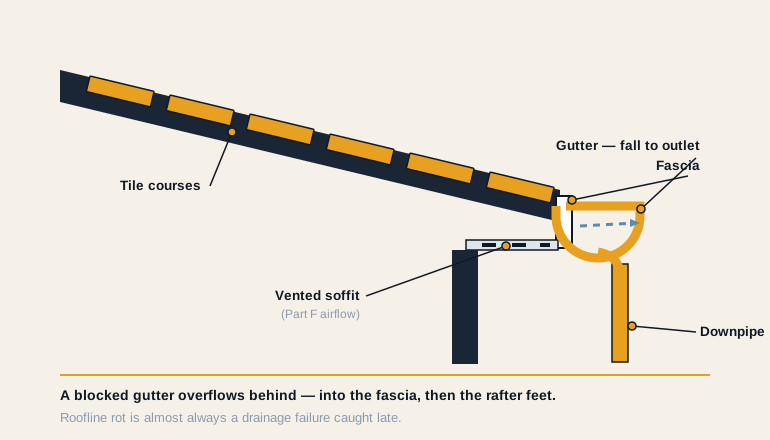
Blocked or failed guttering sends water down the wall and into the house. In Malvern the trees make it a recurring issue.
The Worcester Factor in Guttering
When we take on guttering in Worcester, the first thing that shapes the job is the place itself. Worcester is the city on our patch, a dense mix of Victorian terraces, cathedral-quarter heritage and suburban estates. The city runs from medieval and Georgian stock around Friar Street and the Tything, through dense Victorian terraces, out to inter-war and post-war suburban estates. You see it clearly around the terraces off the Tything, where the roofs tell you the era of the street at a glance.
In the Victorian terrace belt the constant is rear-valley and parapet-gutter failure: terraced roofs share hidden valleys and box gutters that block and back up, leaking into the bedrooms below. On the Friar Street heritage core in particular, that is the fault we are called to most, and it is worth knowing what drives it before you pay anyone to fix it: the symptom you can see from the ground is rarely the whole story, and a Worcester guttering quote that skips a proper look is guessing.
Materials and consent: The cathedral quarter and much of the historic core are conservation-controlled, with listed buildings around Friar Street. We work to that from the survey onward, so your guttering both looks right and keeps you the right side of the planners — there is no point saving on materials only to be told to redo the work to match the Worcester streetscape.
City-centre terraces mean rear-access scaffold and permit-controlled pavement space; Worcester City Council governs the licences and the core streets are tight. Severn valley humidity slows drying and keeps north-facing city roofs damp well into autumn. Both of those feed directly into what your guttering should cost and how long it takes, which is why we survey the actual property near the Tything rather than quoting from a national rate card — two houses a few streets apart in Worcester can need genuinely different work, and pricing them the same helps nobody.
On Worcester terraces we always check the shared rear valley first; it is the single commonest hidden cause of an upstairs leak in the city. That local knowledge is the difference between a Worcester guttering job that lasts and one that has you calling someone back in two winters. It is also why we would rather turn down a job we cannot do properly than take it on and cut a corner the Worcester weather will find.
All of this shows up in the price. A guttering quote for a property on the terraces off the Tything will not match one for a different era of house two streets away, because rear-valley and parapet-gutter failure on Victorian terraces and the access it needs are what actually drive the cost here. We would rather show you an itemised Worcester quote you can question line by line than a round number that hides where the money goes.
On the day in Worcester: for guttering here, scaffold is specified where the job involves tall Victorian villas, three-storey frontages and full roofline packages, and where a tower or roof ladder is safe we use that instead to keep the cost and disruption down. Any pavement scaffold or skip licence goes through Worcester City Council, which we arrange, and we plan it around Worcester’s access. You get a clear start date, a tidy site at the end of each day, and no surprise access charge appearing after work has begun — the single most common complaint we hear about the last firm someone used.
Do you cover all of Worcester?
Yes — we cover Worcester in full, from Worcester Cathedral across to the surrounding streets, and we know the local stock well enough to price guttering accurately before we arrive.
What makes Worcester roofs different for guttering?
The local factor that matters most is rear-valley and parapet-gutter failure on Victorian terraces, and it is made worse because Severn valley humidity slows drying. Knowing both is how we quote Worcester work fairly rather than off a national average.